


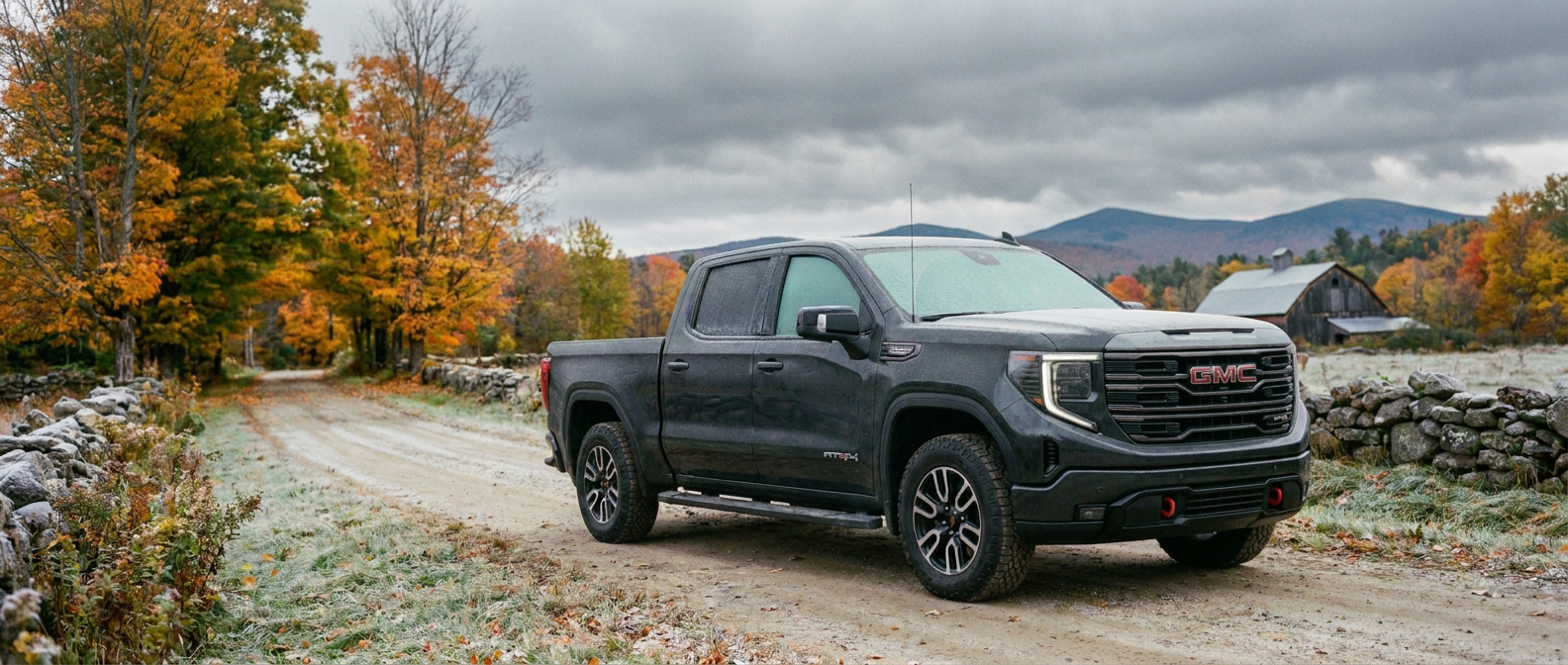
October 1st in Keene means something specific. According to climate records, Keene's snowy period begins on average around October 28, which gives you roughly four weeks to get your truck ready to work in it. Spend those weeks loading the bed with sand, salt, ice melt, and winter gear. Good prep is what separates a truck that handles a February thaw with confidence from one that's spinning on Route 12 in November.
The 2026 GMC Sierra 1500 is more than capable of carrying everything you need. We'll walk through whether it all fits, how to load it correctly, and what to check under the hood before the first storm arrives.
Will It All Fit?
Yes, everything fits, and with room to spare, though the ceiling here is your door-jamb payload rating rather than the bed's physical floor space, so you'll want to plan the whole load around that sticker before you buy a single bag of sand. The 2026 Sierra 1500 standard bed measures 79.44 inches long and 71.4 inches wide at the floor, with 50.6 inches of usable width between the wheel housings and 71.7 cubic feet of cargo volume. A standard 4-by-8 sheet of plywood (48 inches wide) lies flat between the wheel wells in every Sierra 1500 bed configuration. The most common winter-prep loads work out like this.
| Item or Load | Dimension / Weight | Fits? How? |
|---|---|---|
| 80 lb. bags of sand (ballast) | 80 lbs each | Yes. 10 bags = 800 lbs; well within Crew Cab payload |
| 50 lb. bags of ice melt | 50 lbs each | Yes. 20 bags = 1,000 lbs; combine with sand ballast up to your door-jamb sticker limit |
| Snow blower (single-stage, typical) | ~65 lbs, ~24 in wide | Yes, flat on the bed floor or against cab wall |
| Snow blower (two-stage, typical) | ~250 lbs, ~28 in wide | Yes, fits width-wise; ramp carefully over tailgate |
| Roof rake + shovels, stacked | Up to 60 in long | Yes, laid flat against the cab wall |
| 4x8 plywood sheet (storm boards) | 48 in wide | Yes, drops flat between wheel wells |
| Generator (portable, ~200 lbs) | Varies; most under 30 in wide | Yes, secure to bed tie-down points |
| Sand spreader (broadcast type) | ~50 lbs, fits standard hitch | Yes, hitch-mount; doesn't use bed space |
GMC publishes a maximum payload of up to 2,020 pounds for the Sierra 1500 Crew Cab Short Bed, properly equipped. The Regular Cab Long Bed configuration reaches up to 2,230 pounds. For your specific truck, the actual number lives on the tire-and-loading label inside the driver's door jamb. Trust that sticker over the brochure every time; it's the number that counts.
One caveat is worth flagging. Payload includes the driver, passengers, and everything in the cab too. With two people up front, that's roughly 350 pounds gone before the first bag of sand hits the bed. Plan accordingly.
Schedule your pre-winter service before you start loading, because a well-prepped truck handles those loads more predictably. You'll notice it the first time you brake on a slick road. More on that below.
Loading It Right for a Keene Winter
Load your sand and salt ballast low in the bed, forward of the rear axle and centered side to side, which keeps the weight over the drive wheels where your AWD and 4WD can put it to work, though that payoff only shows up if you strap the bags so they can't slide. An HD truck owner hauling heavier commercial loads follows the same principle, just at higher weights.
A few things matter a lot in practice. Keep loose ballast bags stacked tight against the cab wall, and use the Sierra's four bed tie-down hooks (one at each corner) to strap down anything that could shift. Shifting weight during braking on an icy road is how bags end up against the tailgate instead of over the axle where they belong. It's a 30-second strap job. Worth doing.
Does all-wheel drive cancel out worn tires? No. It sends power to the wheels with the most grip, and it doesn't override physics. Ballast over the rear axle gives those rear tires more contact and more bite on an unplowed side road, which is exactly the condition where it helps most. AWD and 4WD work alongside proper tire tread and correct tire pressure, not in place of them.
Tread and Pressure Check: Tire pressure drops approximately 1 PSI for every 10 degrees Fahrenheit the temperature falls. Keene's January average low sits around 10 degrees Fahrenheit. Set your tires at 35 PSI on a 65 degrees Fahrenheit October afternoon and they could be running 5 or 6 PSI low on a January morning before you've driven a mile. Check your door-jamb placard pressure rather than the sidewall maximum, and check it on cold tires.
Getting There Step by Step
Running the prep in the right order saves you from scrambling once a storm rolls in, so here's the sequence we'd work through in October before Keene's roads change, and none of it takes a full weekend if you spread the tasks across a few evenings.
- Pull the door-jamb payload sticker. Write down that number. Subtract the weight of your intended load plus all passengers. What's left is your real working margin. Don't estimate.
- Check tire pressure cold (parked overnight, before driving). Set it to the door-jamb specification rather than the sidewall maximum; that's the figure your truck is actually tuned for.
- Inspect tread depth on all four tires. The U.S. Tire Manufacturers Association notes that tires begin losing meaningful traction in winter conditions at 4/32 of an inch of tread remaining, well above the legal limit of 2/32. If you're at or near 4/32, replace them in October while you can, before December gets here.
- Have the battery tested. Cold weather requires a fully charged battery in good condition to start the engine reliably. If your battery is more than three to four years old, test it now. A battery that's borderline in September will often fail in January.
- Top off washer fluid with a winter-rated formula. Keene road crews use salt and sand mix heavily from November through March. You'll go through washer fluid faster than you think.
- Load ballast forward of the rear axle, strapped. Follow the door-jamb payload limit. If you're running ice melt in a broadcast spreader on the hitch, remember that tongue weight counts against payload too.
- Confirm 4WD or AWD engagement. In a safe, low-speed setting (not dry pavement), confirm the system engages and disengages cleanly. If you're not certain it's working right, bring it in before November.
Schedule Your Pre-Winter Service Check
Job Done.
The fall prep haul comes down to a handful of numbers, and the encouraging part is that your 2026 GMC Sierra 1500 has more than enough capacity for the job, so the calendar ends up being the only thing that's really working against you between now and the first storm. The 2026 Sierra 1500 standard bed holds 79.44 inches of length and 71.7 cubic feet of volume, the Crew Cab Short Bed carries up to 2,020 pounds properly equipped, and Keene's snowy season starts by the last week of October on average. The gap between "I'll get to it" and the first real storm is shorter than it feels in early fall.
Load the ballast low and forward. Check the door-jamb sticker over the brochure number. Test the battery and the tire pressure while it's still 55 degrees outside and the checks are easy. Then you're ready for whatever NH Route 9 or Route 12 brings between now and April.
If you want to explore the 2026 Sierra 1500 on our lot or talk through which bed and cab configuration fits your actual winter hauling needs, our team at Fairfield Buick GMC on Winchester Street in Keene is the right place to start, and we'll walk it through with you.
By the Fairfield Buick GMC Team | October 2026