


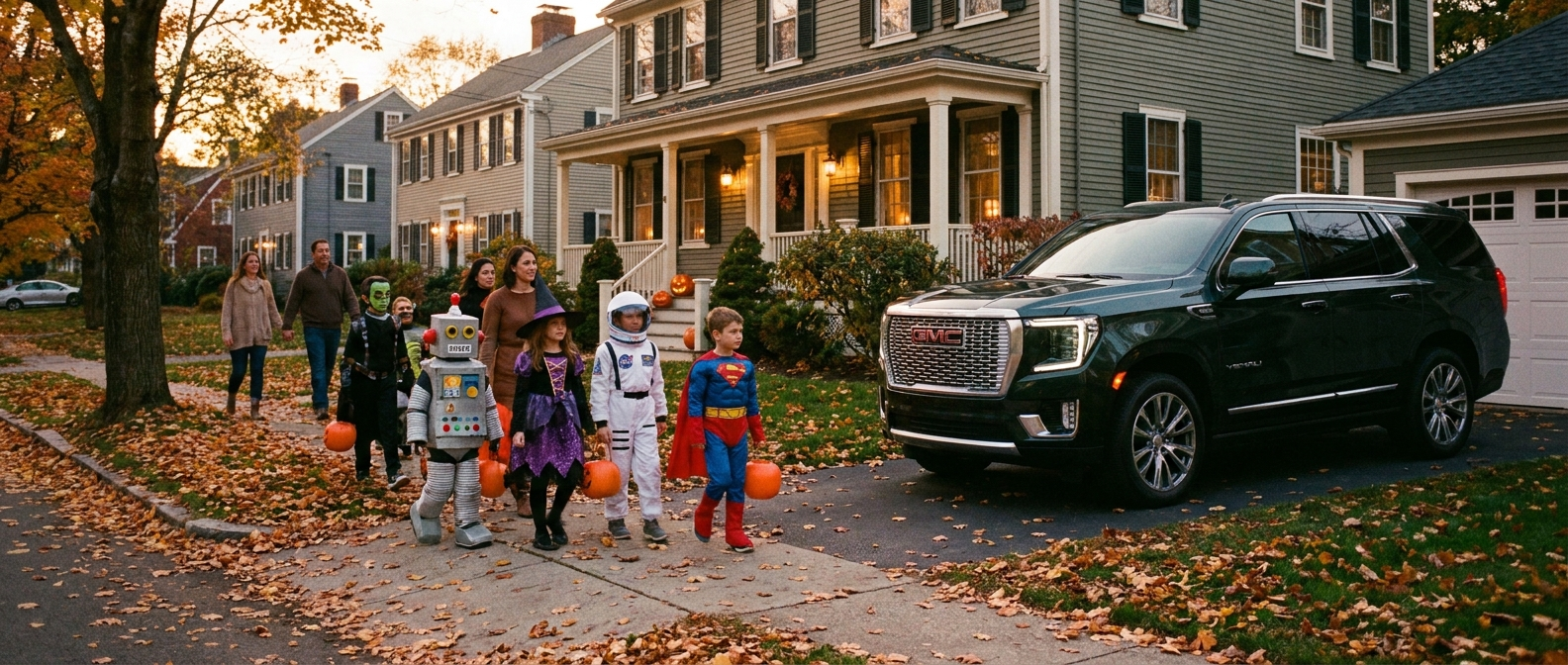
Halloween in Keene falls on a Saturday this year, so you'll see more families out longer and more drivers cutting through residential streets. The core answer is simple. The riskiest window lands right around 6 PM, the exact center of the Monadnock Region's typical trick-or-treat hours, and it's a visibility problem on both sides of the windshield. Slow down before you see a child, not after.
A full-size family hauler is one of the vehicles we park in these same neighborhoods, and our team knows the view from behind the wheel. A dark costume at dusk blends against a leaf-covered lawn in ways that catch even an alert driver off guard.
What to Do, and What Not to Do
What to do splits cleanly into two columns, and the short version is to slow down and look twice, because a study published in JAMA Pediatrics, drawing on 42 years of NHTSA fatality data, found pedestrian risk is 43% higher on Halloween evening compared to the same hours the week before and after. Children between 4 and 8 years old face a 10-fold increase in fatality risk. Risk peaks around 6 PM, not later in the night when you'd expect it.
Scan the two columns below before you head out, and keep the don'ts in mind.
| Situation | Do | Don't |
|---|---|---|
| Backing out of your driveway | Walk the driveway first, look both ways, back slowly | Rely only on the camera; kids crouch below sensor range |
| Passing a stopped vehicle | Stop, wait, confirm the street is clear | Pass or go around it; it may be dropping off trick-or-treaters |
| Posted speed through neighborhoods | Drop 5 mph below the posted limit | Assume the posted limit is fast enough for foot-traffic conditions |
| Headlights | Turn them on well before dusk | Wait until full dark; low-light is when the risk is highest |
| Seeing one child crossing | Look for the group behind them before moving | Proceed after the first child clears; others follow without looking |
| Intersections and driveways | Full stop every time; make eye contact | Roll through assuming you'd see a child in time |
| Dark or all-black costumes on the street | Leave extra distance, scan the lawn edges | Expect the costume to behave like adult pedestrian clothing |
NHTSA specifically advises drivers to watch for children in unexpected places, including between parked vehicles and exiting driveways. Those aren't edge cases on Halloween. They're the normal pattern.
The Driveway Moment Is the One Technique That Matters Most
The single most useful thing you can do on Halloween night is get out and walk your driveway before you back out, which sounds like overkill on any other evening but earns its keep when small costumed kids are crossing lawns in the dark. Every experienced driver has a mental checklist for residential driving. One addition is the piece almost nothing else calls for.
The reason is mechanical, and worth spelling out. A child crouching to pick up a dropped piece of candy, or a small kid in a bulky costume, sits below the field of view of most backup cameras. The camera's calibrated to detect vehicles and standing pedestrians, so at dusk, in a dark costume, against asphalt, the sensor may not register what your eye wouldn't catch either. Stepping out takes ten seconds. It removes the variable entirely.
For the drive itself, NHTSA advises slowing down and watching for children who may unexpectedly enter the road. In Keene's residential neighborhoods, that means treating every gap between parked cars as a potential crossing point, because children on Halloween routinely cross mid-block and between vehicles rather than at corners.
Families heading out in a mid-size SUV and those in a larger Buick share the same tradeoff. A higher seating position improves the sight line down the block, but it also increases the blind spot directly in front of and behind the vehicle. That's worth remembering any time you're moving the vehicle near pedestrian traffic.
A few things worth carrying into Halloween night: - Turn headlights on at least 30 minutes before trick-or-treating begins, not at sunset - Check seatbelts for every occupant before moving the vehicle, even for a short block - If you're dropping kids off, pull fully to the curb and wait until they're on the sidewalk before moving - Keep windows cracked slightly so you can hear what the camera won't always show - Silence your phone before you leave; Halloween neighborhoods call for your full attention
Schedule a Pre-Halloween Vehicle Check
The One-Line Recap Before You Head Out
If you remember nothing else before you pull out of the driveway tonight, keep it to three moves that each do real work, because the margin between a safe night and a close call comes down mostly to light and attention. Check the lights, add a reflective strip to every costume, and put the phone away before the car moves.
Our current inventory includes vehicles with standard rear-cross traffic alert and pedestrian detection, and those tools genuinely help. But no driver-assistance feature substitutes for a full stop and a real look on a night when the streets belong to four-year-olds in dark capes.