


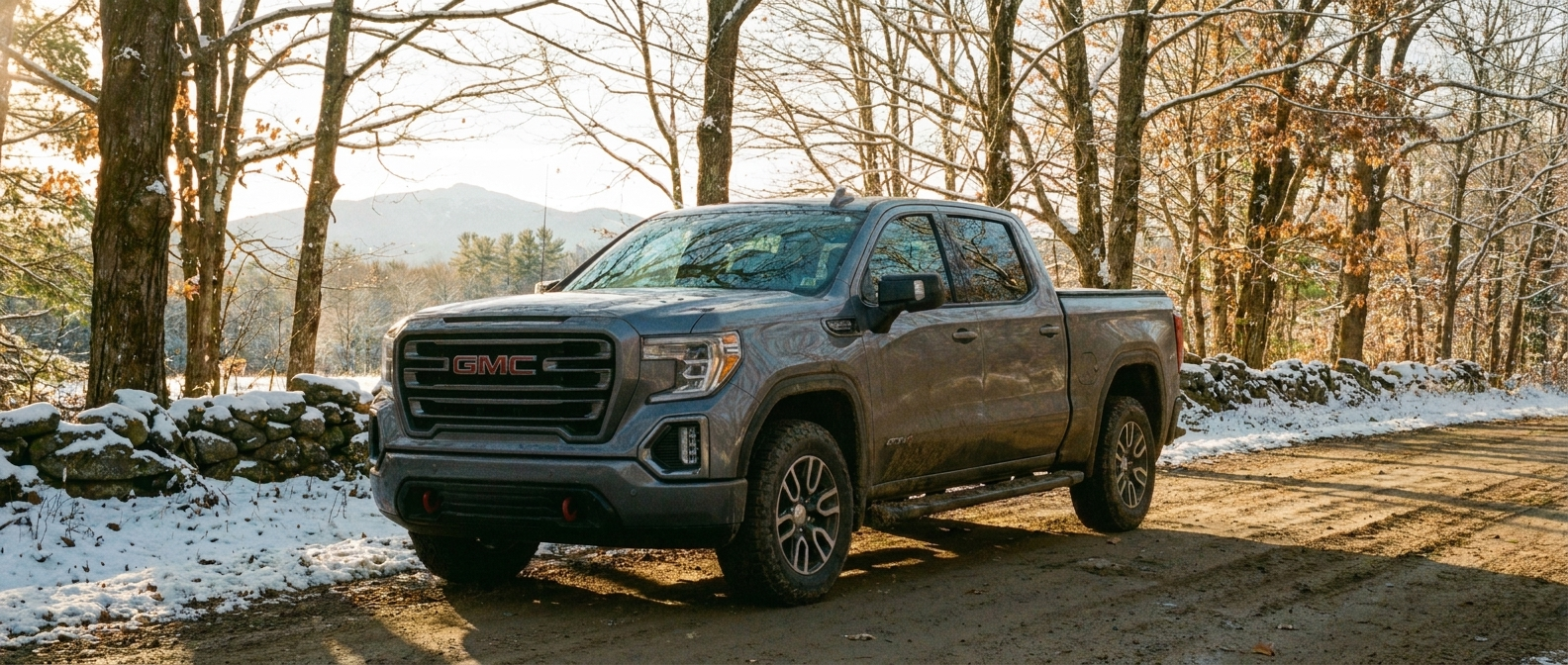
Keene's average first measurable snowfall lands around November 26, which puts us about six weeks out. The first flake isn't what catches drivers, though. A hard freeze usually arrives ahead of it, and it exposes every weak link in your vehicle's starting, stopping, and traction systems before the roads get complicated.
At Fairfield Buick GMC, the October service window is the easy one to work with. Come in then and you leave in good shape. Wait until the first serious storm and you're often dealing with a battery that won't crank and tires that aren't ready for the roads. So here's how our team sorts it, split into three tiers of urgency and effort, with a comparison matrix sitting at the center.
Schedule your pre-winter service check with our team here.
The short version
- Battery: Shop check, not a driveway guess. A battery at 32 degrees F loses up to 35% of its rated cranking power, per AAA research, and summer heat is what actually kills them first.
- Tires: Tread AND pressure, both now. Tire pressure drops roughly 1 PSI for every 10 degrees F of temperature decrease, which means a tire set at 35 PSI in September can read below 30 PSI in January's single-digit lows.
- Coolant: Mix ratio matters more than level. A 50/50 antifreeze-to-water ratio protects to around -34 degrees F; straight water would freeze well above that.
- Wipers and washer fluid: The one driveway fix most people skip until they're already scraping ice at 7 a.m.
- Oil: Your owner's manual may call for a thinner grade in cold weather; don't assume what worked in July still works in January.
How Do These Five Checks Actually Compare?
The five checks split by effort and timing, and the short version runs like this before the table fills in detail, with battery and coolant belonging in a shop, tires and oil landing part driveway and part shop, and wipers staying a quick job you'll handle yourself. Each line tells you what fails, when the failure shows up, and who should handle it.
| Check | What fails without it | DIY or shop? | Urgency before Nov 1 |
|---|---|---|---|
| Battery | Won't crank on the coldest morning | Shop (load test required) | High. Do this now |
| Tires (pressure + tread) | Reduced grip, longer stopping distance, TPMS light | DIY monthly + shop if tread is borderline | High. Pressure check is free today |
| Coolant/antifreeze mix | Coolant slushes at extreme cold, stops circulating | Shop (measure, don't judge by color) | Medium, before first hard freeze |
| Wipers + washer fluid | Smeared ice on the windshield, frozen nozzles | DIY | Low urgency, high annoyance factor |
| Engine oil | Cold-thickened oil strains the starter and battery | Shop (if you're near your interval) | Medium. Check mileage now |
Here's the tradeoff worth being clear about. If you only have time to do two things before November, make them the battery and the tires, since those two create the most cold-weather no-starts and lost-traction situations. The rest matter. They just won't strand you.
Why Does the Battery Matter So Much Before Cold Weather Hits?
The battery takes the hardest hit from cold, and the physics are simple, because low temperatures cut its cranking power at the same moment your engine needs more to turn over thick, cold oil, and it'll often test fine in mild October air and then strand you on the first truly cold morning.
The mechanism is straightforward once you see the numbers. AAA research shows that at 32 degrees F, a vehicle battery loses up to 35% of its rated cranking power. Drop to 0 degrees F, which Keene regularly sees in January when average lows sit around 10 degrees F and can dip lower, and that loss reaches roughly 50% of rated capacity. Meanwhile the engine is demanding more energy to turn over cold, thickened oil. Put reduced output next to higher starter demand and you've got the no-start on a Tuesday morning when you have somewhere to be.
Why does a battery that cranked fine all summer suddenly quit in January? Because summer heat does most of the internal damage months earlier, and the first deep cold just shows you how much capacity it's quietly lost.
If your battery is four or more years old, a load test is the call. It measures real cranking performance under simulated cold conditions, and it'll tell you how it behaves in the weather that actually matters.
Our GMC Sierra 1500 lineup and full-size SUVs like the GMC Yukon both run high-demand electrical systems (heated seats, remote start, trailer brake controllers) that pull extra draw from the battery. Run those features all winter and you'll want to know your battery is genuinely healthy before the temperature drops, while there's still time to act on what you find.
Book a Pre-Winter Battery and Brake Inspection
What Tires, Pressure, and Tread Depth Actually Tell You
Your tires tell two separate winter stories and both want checking right now, so start with pressure, since it'll slide along with temperature on a predictable curve and drop below spec with no leak at all, then move to tread depth, your real grip on snow and slush.
Tire pressure drops approximately 1 PSI for every 10 degrees F decrease in temperature, a rule confirmed by AAA, NHTSA, and every major tire manufacturer. Picture how that plays out in Keene. Set your tires to 35 PSI on a warm 70 degrees F October afternoon, then let January hand you an overnight low of 10 degrees F, a 60-degree swing, and those tires can be sitting near 29 PSI by morning with no slow leak anywhere. By then you're already below most vehicles' recommended inflation and well into TPMS warning territory. No leak needed.
Check pressure when the tire is cold, meaning parked three or more hours or driven under a mile. Use the number on your door jamb placard, and treat the maximum stamped on the sidewall as a separate spec you can ignore for this. They're two different numbers.
Tread depth is the other half of the story. New Hampshire sets the legal minimum at 2/32 of an inch, but for real grip in snow and slush, most tire professionals want to see at least 4/32. Try a quick field test in the driveway. Slip a quarter into the tread groove with Washington's head pointing down, and if you can spot the top of his head, you're close to the point where grip in wet and packed snow starts to go.
The GMC Terrain and the other all-wheel-drive vehicles we stock send power to whichever wheel has the most traction, but they still need real tread to work with. AWD helps you get moving, but it can't fix a worn or underinflated tire. The rubber still has to grip.
On a 60 degrees F temperature swing from a warm fall afternoon to a January morning, tire pressure can drop approximately 6 PSI through physics alone, with no leak, no damage, nothing wrong except the calendar.
Pros and Cons: Handling Winterization Yourself vs. Scheduling a Shop Visit
| Pros (DIY) | Cons (DIY) |
|---|---|
| Free for basic checks (pressure, wiper fluid) | Can't load-test a battery at home |
| Can be done on your own schedule | Coolant protection requires a refractometer or test strips, most people don't own one |
| Wiper blade replacement is genuinely simple | Tread depth gauges are inexpensive but judgment calls on worn tires often need a second opinion |
| Keeps you aware of your vehicle's condition | Easy to defer when the weather is still nice in October |
| Pros (shop visit) | Cons (shop visit) |
|---|
Load test gives you a real battery health number | Requires scheduling ahead in October (our service bay books up) Coolant mix can be measured precisely | A visit takes time out of your day Trained eyes catch adjacent issues (belts, hoses, brake hardware) | Costs more than doing it yourself, though far less than a winter breakdown
Which Winterization Option Fits Your Situation?
The right winterization plan depends on your vehicle's age and how hard you run it, so match the work to your situation and don't treat every line as mandatory, because a high-mileage truck earns the full list and a nearly new crossover needs only the quick driveway checks.
You drive a newer Buick or GMC crossover with under 30,000 miles. Pressure and wiper fluid are your driveway jobs. Confirm your oil interval and coolant schedule against the owner's manual. A battery on a two-year-old vehicle is almost certainly fine, though it's worth a quick test while you're in the service bay for anything else this fall.
You're running a vehicle with 60,000-plus miles, or one that's four-plus years old. Do the full check, battery load test included. Belts and hoses get brittle in the cold, and rubber that looked fine in August can crack under the stress of a January cold snap. Vehicles in this group are also the ones that'll be riding on tires near the 4/32 threshold without the driver realizing it.
You work a trade or run a small business, and your Sierra HD or Savana Cargo is a piece of equipment. Downtime is a cost you measure in lost jobs. The battery and tire checks matter here as much as on any commuter vehicle, and more so when the truck's sitting outside overnight. Get it on the calendar before the first storm.
Frequently Asked Questions
When should I winterize my vehicle in Keene?
Aim for the October service window, well before Keene's average first measurable snowfall around November 26. A hard freeze usually arrives ahead of the first flake, so the earlier you check your battery and tires, the better.
Why does my battery fail in winter when it was fine all summer?
Summer heat does most of the internal damage months earlier, and the first deep cold just reveals how much capacity it's quietly lost. At 32 degrees F a battery loses up to 35% of its rated cranking power, and that climbs toward 50% at 0 degrees F.
Can I check tire pressure and tread myself, or do I need a shop?
Pressure and wiper fluid are driveway jobs you can handle yourself, but a battery load test and precise coolant measurement really need a shop. For tread, slip a quarter into the groove with Washington's head pointing down, and if you can see the top of his head, it's time to get a second opinion.
FAQ: Q: When should I winterize my vehicle in Keene? A: Aim for the October service window, well before Keene's average first measurable snowfall around November 26. A hard freeze usually arrives ahead of the first flake, so the earlier you check your battery and tires, the better.
Q: Why does my battery fail in winter when it was fine all summer? A: Summer heat does most of the internal damage months earlier, and the first deep cold just reveals how much capacity it's quietly lost. At 32 degrees F a battery loses up to 35% of its rated cranking power, and that climbs toward 50% at 0 degrees F.
Q: Can I check tire pressure and tread myself, or do I need a shop? A: Pressure and wiper fluid are driveway jobs you can handle yourself, but a battery load test and precise coolant measurement really need a shop. For tread, slip a quarter into the groove with Washington's head pointing down, and if you can see the top of his head, it's time to get a second opinion.
Categories:
Service