


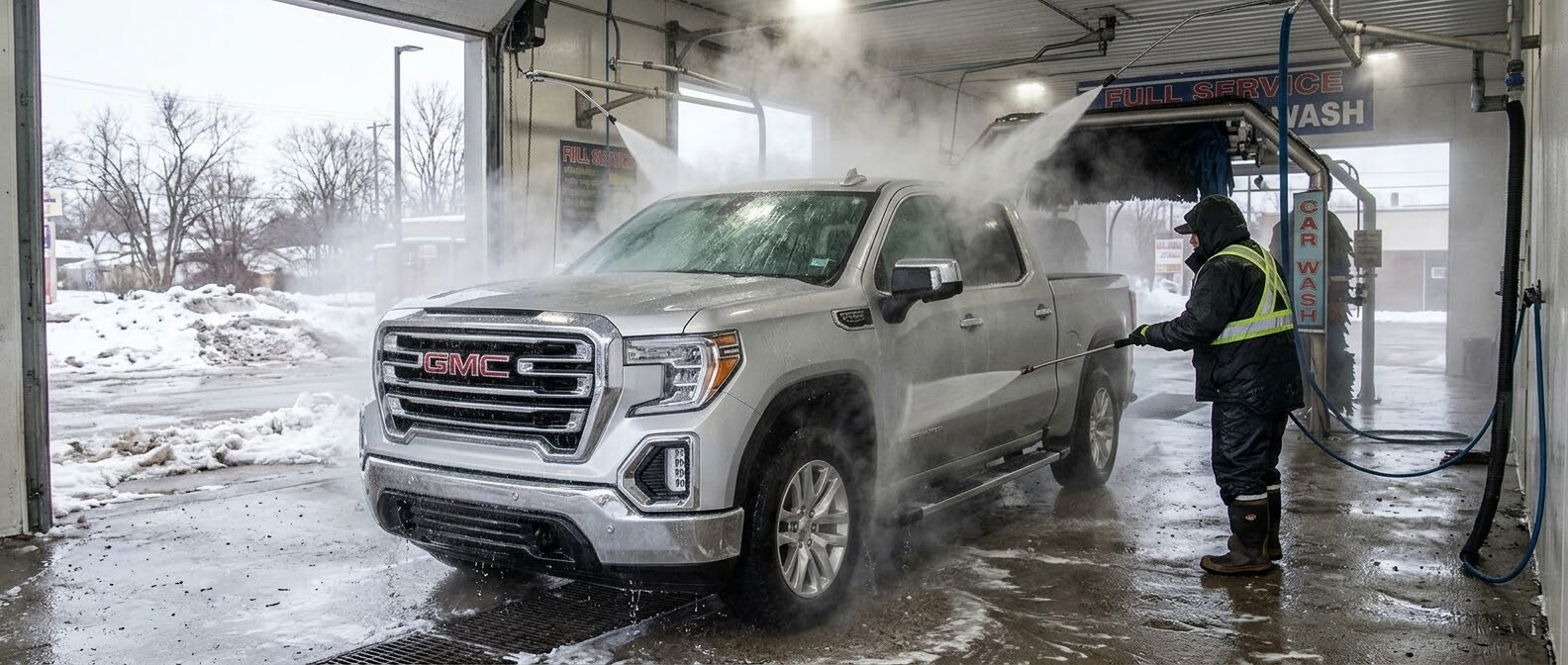
One fall wax job won't get you through a Keene winter, and that's the honest place to start. Here in the Monadnock Region, the roads get pre-treated with liquid brine on top of rock salt now, and brine behaves nothing like the dry granular stuff our parents drove through. It stays wet on metal at much lower humidity, so corrosion starts faster and runs longer than you'd expect. Protecting your vehicle is still straightforward. You just have to know what you're fighting.
Book a pre-winter inspection with our service team before the first big storm if you haven't already. It's the single best way to catch existing chips, seam cracks or drain plugs that give brine a direct path to bare metal.
What Does Road Salt Actually Do to Your Vehicle?
Salt does its damage by pulling in moisture and forming an electrolytic solution that speeds up metal oxidation, and that chemistry runs the same whether you're dealing with rock salt or the liquid brine on major roads today, though the brine carries one nasty edge that the dry stuff doesn't. It dissolves and stays active at roughly 20 to 30 percent humidity. Rock salt stays in a dry crystal state until the air hits about 70 percent humidity. Normal New England winter air sits well above that 20 to 30 percent mark, so brine keeps working on your undercarriage even after the roads look dry.
Underneath, the worst-hit parts aren't the ones you can see. Your door paint takes a beating, sure. But the hidden components carry the load.
| Component | What salt does to it | First warning sign | Your move |
|---|---|---|---|
| Brake lines | Electrolytic corrosion thins the steel tube walls that carry hydraulic pressure | Soft or spongy brake pedal feel; visible scale on lines | Undercarriage wash every 10-14 days; have lines inspected in spring |
| Exhaust system | Corrodes from outside (road spray) and from acidic combustion products inside | Rattling hangers; louder exhaust note | Regular rinse of the underside; replace corroded hangers early |
| Suspension components | Springs, control arm bushings and links pit and lose structural integrity | Clunking on rough pavement; uneven tire wear | Spring inspection; address any surface rust before it spreads |
| Frame and rocker panels | Salt brine seeps into seams and drain holes, attacking from inside out | Bubbling paint at the bottom edge of door panels or rockers | Touch up chips and paint breaks before winter; undercoating on seams |
| Wheel wells | Packed slush traps moisture against steel for days at a time | Visible rust streaking on the inside of the wheel opening | Rinse wheel wells after every significant storm |
| Interior floor | Salt-laden slush carries in on boots, sitting in carpet and migrating to the floor pan | White crusty stains on carpet; rust bubbles under floor mats | All-weather rubber mats; vacuum and dry the interior regularly |
How Do You Stay Ahead of It Through the Season?
Staying ahead of salt comes down to consistency more than any product you can buy, and we see the proof every spring in the difference between vehicles that got rinsed on a schedule and the ones that only saw a full wash when the paint finally looked bad. Wash frequency matters most on the undercarriage, since that's where salt piles up and hides from view.
During active salt season, aim to wash the undercarriage every 10 to 14 days. After a major storm, do it sooner. Use a car wash with an underbody spray setting, or a pressure washer with a wand that reaches under the vehicle. Focus on the wheel wells, the area behind the rear wheels where slush packs in, and the frame rails that run the length of the vehicle.
The GMC Sierra 1500 and other trucks earn extra attention here. With larger wheel openings and a higher ride height, more slush reaches the frame and bed underside every time you roll through a puddle. That's no design flaw. Your rinse routine just has to reach farther back than it would on a low crossover.
Addressing paint chips and scratches before winter (not after) is the other step that pays off. Any spot where bare metal shows gives brine a direct path past the factory coating. Touch-up paint now costs a fraction of what a rust repair runs down the road. Rocker panels and the lower front fascia take the most stone chips on New Hampshire roads, so start with those.
A GMC Terrain or other crossover rides lower to the road, so the splash line on the door sills gets hammered constantly. Keep an eye on the lower door edges and the front valance, where chips are easy to miss and brine pools in the crease.
Watch out for the warm-garage trap. Pulling a salty, wet vehicle straight into a heated garage every night speeds corrosion up. Heat plus brine plus humidity makes an ideal home for oxidation. Rinse the undercarriage before you garage it when you can, or at the very least rinse once on the warmest day of the week so the vehicle has time to dry.
Your Winter Salt Protection Checklist
- Wash full vehicle, including undercarriage, before first snow of the season
- Touch up all visible paint chips (rocker panels and front fascia first)
- Apply a fresh coat of wax or paint sealant to exterior surfaces
- Check undercarriage drain holes in rocker panels and sills; clear any that are blocked
- Install all-weather rubber floor mats front and rear
- Switch to winter windshield washer fluid rated for below-freezing temps
- Wash undercarriage every 10-14 days throughout active salt season
- Rinse after every significant storm before garaged storage
- Inspect brake lines, suspension and exhaust visually at the mid-season point
- Do a full undercarriage inspection and deep wash when mud season breaks in spring
Plan the Full Season This Way
Plan your salt protection as a three-phase routine that runs before the season starts, through the season, and after it ends, because each phase guards against a different problem and skipping any one of them leaves a gap the brine will find.
Before the season is when prep pays the biggest dividend. Give the vehicle a thorough wash top to bottom, touch up any paint break that exposes metal, and lay down a fresh wax or sealant so your clear coat has a barrier in place before the first brine hit. Book a service inspection too, while it's still comfortable for your technician to get under the vehicle and check brake lines, suspension seams and drain plugs with a fresh eye.
Through the season comes down to the wash cadence above. Route 9 passes through Keene. On that road and the other heavily pre-treated arterials around town, the brine goes down before the storm, not just after, so your vehicle picks up road treatment even on a commute where it barely snows. Wash soon after any pre-treatment event, and don't wait for visible accumulation.
After the season is the phase most vehicles skip, and it may be the one that matters most. A thorough spring wash, especially the undercarriage and wheel wells, clears the last of the season's salt and brine out of the seams and crevices where moisture would otherwise sit through mud season. Follow it with a visual once-over. Look for new rust spots, listen for new rattles on rough pavement, and check the lower door edges and rocker panels for bubbling. Catch those things now, while they're small, and you'll pay a fraction of what they cost in a year or two.
If corrosion has already crept in, or you're weighing whether a vehicle that's eaten a few hard New England winters is worth protecting versus trading for something with cleaner undercarriage steel, get a trade-in estimate from our team. Sometimes the math is clear cut. We're glad to give you a straight read.
By the Fairfield Buick GMC Team | November 2026
Schedule a Winter Service Check
Frequently Asked Questions About Winter Vehicle Protection From Salt and Slush
Does brine really damage a vehicle faster than regular road salt?
It tends to, yes, and the chemistry explains why. Standard rock salt stays in a solid crystal state until humidity climbs to around 70 percent, which doesn't happen much in a dry winter. Liquid brine with magnesium chloride dissolves and stays active at humidity as low as 20 to 30 percent, well within normal winter air. So the brine your vehicle picks up on a Monday commute down a pre-treated road is still chemically active on the frame rails when you park Tuesday night. The fix is the same either way. Rinse the undercarriage on a regular schedule.
How often should I actually wash the undercarriage in winter?
Every 10 to 14 days is the practical target during active salt season, plus a rinse after any significant storm or brine pre-treatment. The temptation is to skip it when it's cold and the car just looks dirty rather than white. Salt doesn't care. It keeps working as long as it's sitting on the metal, and the parts it attacks hardest (brake lines, suspension links, frame rails) stay out of sight. Make that undercarriage wash a habit through December, January, February and into mud season, and that's what slows the rust.
Does a heated garage make rust worse?
It can, if you drive in salty and wet. A warm environment speeds up the chemical reaction that turns iron and salt into rust, and brine stays wet at normal indoor humidity levels. If you pull a road-salt-covered vehicle into a 55-degree garage every night without rinsing it, you're giving the brine a warm, moist place to keep working on the steel. The simple habit is to rinse the undercarriage before long garage storage and let the vehicle dry before closing it in. An unheated garage is gentler on a salty vehicle than a warm one, for the same reason.
Categories:
Service